


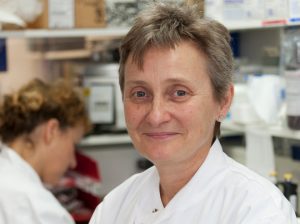
Professor Janet Shipley
Institute of Cancer Research
Awarded: £199,018
Funded in collaboration with The Sarah Burkeman Trust
The challenge
Desmoplastic Small Round Cell Tumour (DSRCT) is a very rare and aggressive cancer that mostly affects teenagers and young adults. It usually grows in the abdomen and is often found late because early symptoms are vague. By the time it is diagnosed, it has often already spread. Current treatments involve very intensive chemotherapy and major surgery, which are difficult for young people to go through, and sadly, they are often not effective enough. Better and kinder treatment options are urgently needed.
How will this project tackle this challenge?
This project aims to understand how DSRCT cells change and adapt as the cancer grows. The team has created advanced 3D models of the tumour in the lab that behave much like real cancers in patients. In these models, cancer cells can switch between different “states”, some look more like the cells that line organs (epithelial cells), while others behave more like cells that make up muscle and connective tissue (mesenchymal cells). Some states may help the tumour survive treatment.
Researchers will track individual cancer cells using coloured markers and genetic “labels” to see how they move between these states and how they react to treatment. They will also study the cells’ genetic activity to find out what drives these changes.
What this means for people affected by sarcoma
By learning which cell types are the most dangerous or treatment-resistant, the team hopes to identify existing drugs that could target them or make current treatments work better. This work could lead to more effective and less harsh treatment options for young people facing this rare and devastating cancer.