


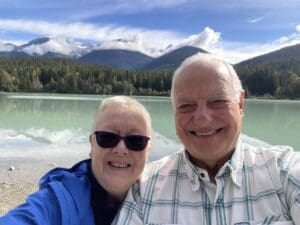
For seven years, Cathy Hampshire’s rare sarcoma cancer went undetected. By the time she was finally diagnosed, a growth doctors had described as small and not very aggressive had reached 15cm. The cancer later spread to her liver, and she was told she had a year to live. Today, more than two years on, she is still here – and as Vice-Chair of GIST Cancer UK she is on a mission to make sure no other patient waits as long as she did.
Cathy, from near Huddersfield in West Yorkshire, has the extremely rare sarcoma cancer – gastrointestinal stromal tumour (GIST).
She first noticed something was wrong when she started bleeding at a friend’s wedding in 2014. After a visit to a doctor and an endoscopy, she was told she had IBS.
The bleeding continued, which was accompanied by stomach pains and frequent trips to the toilet. Further endoscopies followed but nothing untoward was detected.
Her stomach pains got worse in 2019 to the point where she could not walk, eat or drink. Cathy saw a gastroenterologist. A scan found a tiny growth in her stomach that had vanished by the time of a follow-up scan six months later.
Cathy’s pains got worse and it was then that she had a stroke of luck. She saw an upper gastrointestinal consultant at the local hospital who had written his university thesis on GIST. He suspected this is what Cathy had and this was confirmed by colleagues. It was in April 2021 that she was finally diagnosed with GIST in her upper intestine/stomach.
Cathy, who had a career in teaching lasting more than 25 years, had only recently started post as head teacher at a junior school – a role she would eventually have to relinquish.
She was told by medics that GIST was a ‘lucky cancer to have’ as it was not very aggressive. A scan found the growth was 2cms and it was decided that she would have surgery.
The operation eventually took place in October 2021 – but by now, to her shock, the growth had reached 15cms. Despite this, the operation was a success.
She was then put on a drug called Imatinib, the standard treatment for GIST, but Cathy reacted badly. She was then moved to Sunitinib and had the same reaction.
There was a further setback in 2023 when the cancer returned – it had spread to Cathy’s liver and parts of her jejunum.
At one point Cathy was told she had just a year to live. She said: ‘It was a lot to get my head around. I had made my will.’
Her final treatment option was the drug Regorafenib. This time, there was no bad reaction and, after almost three years, Cathy is still taking it. Her condition has stabilised and the GIST has not grown.
After taking medical retirement, she found a new purpose in her role with GIST Cancer UK. It includes raising awareness of GIST and campaigning for better treatments.
She said: ‘I had felt a huge void after my ill-health retirement, but GIST UK helped educate me on what I’d got and it was great to meet other people with GIST.’
GIST is less well-known compared to many other cancers and Cathy has found people have misconceptions about it. ‘I have been told, “you look OK, you can’t have cancer”,’ she said.
Married to Roger with two grown-up children, Cathy, 63, is making the most of life and enjoys photography, painting and travel.
Sarcoma UK’s Director of Fundraising and Communications, Kerry Reeves-Kneip, said: ‘Cathy’s story is both humbling and deeply frustrating in equal measure. Seven years is an extraordinarily long time to be living with a cancer that is going undetected and the consequences – a tumour that grew from 2cm to 15cm, a recurrence, and ultimately being told she had a year to live – show exactly why earlier diagnosis matters so profoundly. As we mark International GIST Awareness Day on 13 July, her experience is a powerful reminder of why awareness of rare cancers like GIST needs to be far greater, both among the public and within the medical community. What makes Cathy’s story so remarkable is not just what she has endured but what she has chosen to do with it. Her campaigning work with GIST Cancer UK, advocating for faster diagnosis, better treatments and greater understanding of this disease, is helping to make a real difference to patients across the country. We have enormous admiration for her, and we are proud to stand alongside GIST Cancer UK in ensuring that people affected by this rare cancer are never without support or a voice.’