


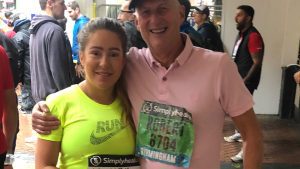
A devoted runner who was repeatedly reassured that a painful lump in his groin was nothing serious died just months later from a rare cancer that doctors failed to diagnose until after his death.
Robert Degville, from Burntwood, Shropshire, had always been fit, active and regularly ran half-marathons with his daughter-in-law Victoria Southall. But when he sought medical help in 2022, the symptoms were initially blamed on a possible abscess, a urinary infection and the strain of his job.
Robert, a security guard, started to feel a lump in his groin in May 2022. He thought it was maybe a pulled muscle due to running or even his job and was referred for a scan.
In early June, he went on a family holiday to Greece and would go for a run each morning. It was then that he began to complain of pain.
By mid-June, he was still waiting for a scan. About two weeks after returning home, his condition worsened – swelling had developed in his thigh. Robert wondered if this was DVT so decided to go to A&E. After waiting 13 hours, he was told it wasn’t and was sent home and told to wait for his scan.
The pain got worse over the following weeks but further GP visits brought no resolution.
Victoria, 34, from Hednesford, had her doubts. ‘As a nurse, I felt it wasn’t being investigated properly.’
In late July, Robert was admitted to hospital via A&E. Visibly in severe pain, he was rushed through triage and was told it wasn’t cancer but an abscess on his psoas muscle. It was decided to drain it.
However, when attempting to aspirate, medics found the mass itself was complex – hard in some places, soft in others. A biopsy of the tissue was taken.
Meanwhile, his condition continued to deteriorate. The lump in his groin had swollen to take over his pelvic region. His appetite had gone, he was very frail and had a distended abdomen.
His leg had also swollen with lymphatic fluid. But still, medics had no answer to what was wrong with Robert.
Blood in the urine was the next symptom. Robert was told it was a urinary tract infection and given antibiotics.
He was admitted to hospital again in August 2022. An appointment on 20 August saw confusion. Robert believed he was getting his biopsy results but was told he was going to be discharged. Victoria demanded he be investigated properly.
Victoria said: ‘It turned out that Robert’s results were sitting in the system unread and unacknowledged. A consultant was left with the devastating task of interpreting and explaining them on the spot to us but told us she’s doing her best and she’s not 100% sure. From there, everything escalated.’
Robert was transferred urgently to a hospital in Derby but never came home. Early in September 2022, he was put on palliative care and died aged 64 a few weeks later. It was only after his death that his biopsy results showed that he had liposarcoma.
‘When we found out it was cancer, we were gobsmacked. The family found it hard to process what had happened, the speed and suddenness of it all. Robert had been strong, active and always moving – the man who never stopped running,’ said Victoria.
‘The family was very much kept in the dark. I could only translate the information we received because I am a nurse. There were so many chances to investigate what was wrong that weren’t taken.’
Victoria said that health professionals need to inform patients and their families better about sarcoma. She said she had to do her own research online and found charity Sarcoma UK’s website a valuable source of information.
Victoria will run the London Marathon on 26 April in memory of him. She said: ‘I am running to honour Robert and to help raise awareness so that no other family has to go through the same experience. This will be my hardest run to date but every mile is for Rob – we love and miss you forever.’
Emily Williams, Research Manager at Sarcoma UK, said: ‘Liposarcoma is one of the most common forms of sarcoma, yet it remains incredibly difficult to treat – and, as Robert’s story shows, far too easy to miss. That’s why the research we’re funding matters so much. We’re currently supporting two projects at the University of Southampton led by Dr Zoë Walters. The first is exploring the genetic changes that drive one of the most aggressive subtypes, dedifferentiated liposarcoma, in the hope of identifying new, more targeted drugs with fewer devastating side effects. The second is building new laboratory models that include immune cells alongside tumour cells to better understand how the body responds to liposarcoma and unlock the potential of immunotherapy for patients. Together, these projects represent exactly the kind of progress we need – because sarcoma is a cancer that is hard to spot, hard to treat and, for too many families, devastating in its speed.’
To donate to Victoria, go to https://www.justgiving.com/page/victoriasouthall