


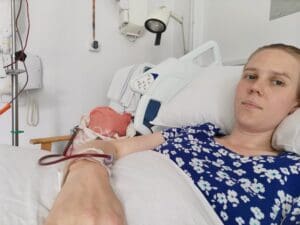
When Heather Hackney was finally told she had cancer, she was sitting alone in a clinic – her husband barred from entering during Covid. The diagnosis, leiomyosarcoma, was as rare as it was devastating. But, as Heather would discover, surviving the cancer was only the start of her journey.
Heather, from York, was about to begin the process of coming to terms with the loss of her fertility.
After she gave birth to her son in 2019, Heather started having pelvic problems. She had an ultrasound that found a mass on her pelvis.
After various scans, she was diagnosed with a fibroid. She was due to have surgery but then the Covid-19 pandemic started and the operation was called off.
The pains in her pelvis got worse, so much so that Heather had to go to A&E a couple of times. The hospital’s gynaecological department said she had internal bleeding from the fibroid. But they sent Heather home. The pain was ongoing and, and in August 2020, Heather passed out at home. She had emergency surgery to remove the fibroid plus a blood transfusion. A sample was then sent for pathology. Heather was told this was routine and nothing to worry about.
Four weeks after the surgery, she then got a call to come into the clinic. This, being during Covid, she was on her own. It was then that Heather was given the shocking news that she had leiomyosarcoma. There is an average of 525 cases of leiomyosarcoma diagnosed every year in England – about 0.17% of all cancers.
She was so shocked that she needed her husband, Chris, to pick her up from the clinic. She said: ‘I was in absolute shock. Nothing really prepares you for it.’ A CT scan found the cancer had not spread beyond her uterus.
Heather had a radical hysterectomy in September 2020, which was followed by radiotherapy ending in February 2021. Since then, tiny nodules have been found on her lungs and she now has regular scans to monitor her health.
She said: ‘I have been on an intense journey since then regarding the loss of my fertility; I did not really try to process my feelings about it while I was going through treatment, and when I did finally start to accept what had happened, I became very depressed. I spent a lot of time working with a cancer psychologist to “grieve” the loss of my fertility. I needed this safe space to work through these emotions, as it wasn’t something I could really talk to my friends and family about.’
She added: ‘My outlook changed. I had to reprioritise everything in life. I would never live as I did before cancer. I would have loved to have had another baby but that was taken away. That is a lot to come to terms with at 32.’
Being in medical menopause has also had a big physical impact on Heather, including in terms of bone and heart health. She has osteopenia (the stage before osteoporosis) and has scans to check her bone density. Her bone health will continue to decline, and she has strength training to try to remedy that.
Heather, now 38, who works in higher education, described Chris as ‘a rock’ during her ordeal.
She called the Sarcoma UK Support Line for advice on her treatment. ‘Going through a cancer diagnosis was both scary and confusing; Sarcoma UK provided help and support when I most needed it and I’m incredibly grateful for that.’
Sarcoma UK’s Support Line Manager, Helen Stradling, said: ‘A sarcoma diagnosis raises so many frightening questions and, for younger patients like Heather, the impact on fertility makes it even harder to process. Our Sarcoma UK Support Line specialists are there to provide clear, expert guidance on diagnosis and treatment, giving patients the knowledge and confidence they need at the most difficult time of their lives.’