


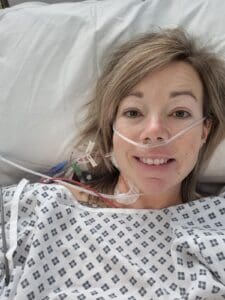
Cerys Watcyns has a cancer so rare that the genetic change driving it has been recorded in only a handful of people worldwide. There is almost no research to tell her doctors what will work.
On 4 October, she will line up for the Cardiff Half-Marathon, her first, a year after her illness took running away from her altogether. ‘Exercise was my way of feeling good, so to have that taken away was difficult,’ she said. The half-marathon, she says, will be a reminder of ‘how far I’ve come from a time when so much of my normal life, even the things I took for granted, was taken away from me’.
It was in autumn 2023 that Cerys, from Newport, felt a mass in her stomach. She had been having issues with bladder retention and was on an NHS list for a scan but decided to go private. A scan found a 15cm fibroid in her stomach and a cystic mass in her rectal area, which was thought to be benign.
More scans followed, and it wasn’t until August 2024 that she was given the news that she had a cancer called endometrial stromal sarcoma (ESS). The treatment recommended for her was a full hysterectomy as well as removal of the tumour and her bowel, so she would need a permanent stoma.
Cerys admits her reaction to being told she had cancer was anger. ‘Cancer was not on my radar. I had done all the right things, exercise, eating healthily. To find I had cancer was tough to deal with emotionally.’
The surgery took place in November 2024. Surgeons decided not to remove Cerys’ bowel and ovaries as they were not sure if her tumour was hormone receptive. Histology after the operation found Cerys had a rare MEIS1::NCOA2 gene fusion, a genetic change that has only been identified in a very small number of sarcomas and is still not well understood.
A few months passed and, in March 2025, Cerys was told the cancer had returned and was growing quickly in the same area. She was advised to have another operation but this time it would be more invasive and potentially life-changing. It would involve a pelvic exenteration, a complex surgery that removes some or all of the organs in the pelvis.
By now, Cerys had returned to work as a physiotherapist and resumed running and exercising. ‘Having only just started to feel like myself again, I wasn’t ready to go through another huge surgery so soon,’ she said.
Cerys sought a second opinion from the Royal Marsden Hospital in London. She was told that she would likely still need surgery but there was another option she could try first, hormone therapy, with the aim of delaying surgery.
‘There was no guarantee it would work,’ she said. ‘In fact, there was very little evidence or research to tell us whether it would work for my particular cancer.’
The hormone therapy, which is ongoing, started in August 2025. Cerys has injections every four weeks and takes tablets daily. The treatment has stabilised the tumour, though there have been complications. Her tumour flares up after each set of injections and she is in a lot of pain, but it then settles down.
Cerys, 37, hopes that, because her cancer is so rare, anything that can be learned through her treatment will ultimately help other patients. But she is aware that a second operation is still something she will need.
Helen Stradling, Sarcoma UK’s Support Line Manager, said: ‘Cerys’ experience will be familiar to so many of the people who contact our Support Line. When a sarcoma is as rare as hers, there is often no clear pathway, no large trial to point to and very few people who have been through the same thing. That uncertainty can be as hard to live with as the treatment itself, and it can leave people feeling very isolated.
‘That is exactly why the Support Line exists. Whatever stage someone is at, whether they are waiting for results, weighing up a decision about surgery or simply having a difficult week, they can talk to a specialist heathcare professional who understands sarcoma. We are here for family members too.
‘Going forward, we want to see rare subtypes like Cerys’ get the research attention they deserve, so that patients are not left making decisions with so little evidence to guide them. Cerys taking on her first half-marathon, while living with all of this, is a remarkable thing to do, and the money she raises will go directly towards that work. We are all cheering her on.’
Cerys says she has had the support of her partner Jade and received counselling, including from Sarcoma UK. She added: ‘Cancer has changed a lot of things for me, but I don’t want it to define my life. I am living with cancer, but I can still live my life. I live more in the moment now. I am less stressed about the little things in life.’
To donate to Cerys, go to Cerys Watcyns is fundraising for Sarcoma UK.